Someone recently asked for my thoughts on “the so-called dilution of yoga in modern practice” and whether “the state of yoga is being widely practised and achieved?”
This clip is an excerpt from our discussion. A transcript follows below.
If you’d like to explore how yogic traditions relate to modern practice, join me online for The Path of Knowledge – it’s a year-long immersion that starts in September. We meet twice a month for discussions, with videos and readings to help us prepare…
“I think the biggest confusion in the modern yoga world is the idea that yoga is a practice. Because that immediately means that yoga means postures. It’s the thing that you do.
“For most of the history of yoga, the idea has instead been that yoga is a state of being that is attained through the doing of something else. Hence these weird Sanskrit compounds – bhakti-yoga, the attainment of the state of yoga through devotion; haṭha-yoga, through physical effort; dhyāna-yoga, through meditation; karma-yoga, through worldly activities.
“So that sort of philological textual analysis, scholarship makes it very clear that there’s always been an understanding [that] there are many paths to this state. And at the same time also there are many ways of embodying that state, so it’s not that they all lead to the same place necessarily.
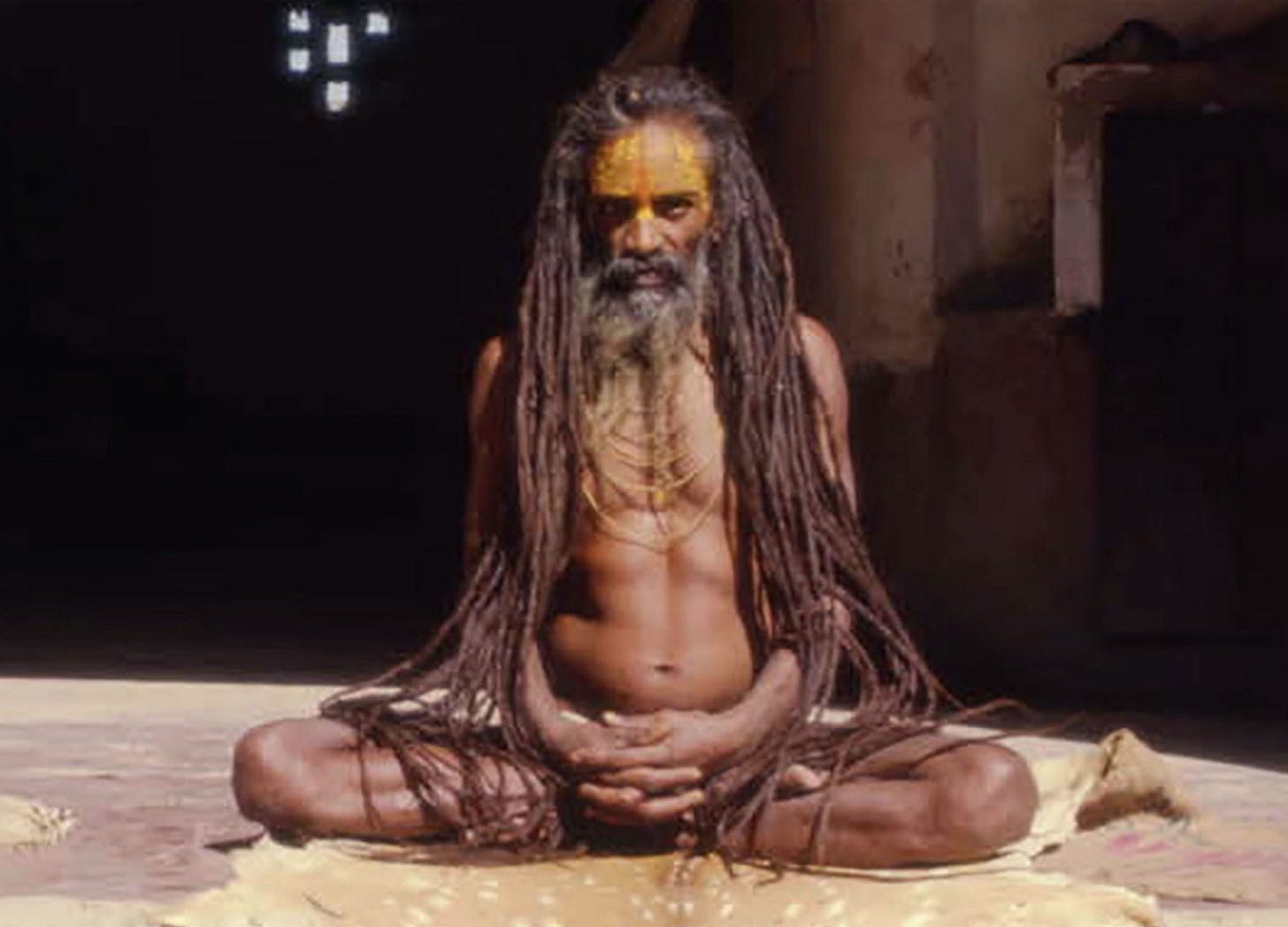
“There is a very world-renouncing tradition, where all that really matters is basically being dead to the world while still alive. And so having no real sensory, mental, or physical engagement with anything, just sort of being the glowing vegetable sat in the corner.
A modern renouncer (Dolf Hartsuiker)
“And then there is the tradition of being so well established in this state of clarity that it’s possible to go about one’s day-to-day business, completely uncontaminated by the things that cause problems to most other people. So unaffected by sorrow, unattached to pleasure, not impeded in any way, in the conduct of day-to-day mundane tasks, happily whistling while you wash the toilets. It’s absolutely fine.
“And then there’s a problem with some of that, because that is part of how the hierarchical structure of Indian society is rationalised in texts like the Bhagavad Gītā, which basically invented this worldly yoga as a tool for propping up social inequality, and combining the ideas of the yogic renouncer with the realities of a worldly society.
“And so there isn’t really out of all of that one definition of what’s there, but there is a number of common threads that we can see in lots of different yogic traditions about something that’s internally clear, that is unafflicted by the ways in which the mind distorts reality, and that most of that ends up coming back to – as the last slide I was pointing out observed – self-centred thinking that tries to rearrange reality to make us feel better, perhaps at the expense of others, and also is fixated on the idea of getting things in order to feel better.
“And the yogic perspective is to really not need anything. Look at the definition of contentment in the Yoga Sūtra. The commentarial lines that go with it basically say it’s to not need any possessions other than what you need for bare survival. And if you can be happy with that, that’s sixteen times better than any other imaginable pleasure, whether it’s in heaven or here on Earth. So, not wanting is really the key. It doesn’t have to mean not doing, but for a lot of yoga history, it did.
“I see an ever more needy, identity-focused, you know, sort of greedy and anger-fueled tendency colonizing the minds of not just the public at large, but those in the yoga world arguing on the internet about what is and isn’t yoga, or what isn’t appropriate behaviour in response to, I don’t know, the politics of the Middle East, whatever else it might be. I do not see much evidence there of any of that. I see, actually, the opposite. And often the people who are shouting the loudest are the least well-established in whatever that clarity might be.
“However, again, we’re talking about this spectrum between two things pulling in the opposite direction – because if you really take that to its extreme, you do have an indifference to the world, and that’s not healthy. We live in a world that’s got a lot wrong with it. And if it’s possible to bring some of that clarity back into day-to-day life, and to try and be at least not part of the problem, and perhaps even part of a solution, then that’s helpful.
“To just say ‘I’m checking out because there’s too much problem’, which seems to have been the go and live in a cave approach, I don’t think helps all that much. So yes, I think the short answer is people are very confused about what yoga means, and are instead arguing about other stuff.
“And, yeah, to a certain extent, I’m part of that problem. I’m talking a lot about the analysis of philosophy and history, and that’s a lot of ‘about yoga’, rather than being yoga. That’s what I do, I’m a yoga nerd, people seem to find that interesting on a certain level, but I’m also mindful of the fact that I’ve put a lot more energy into that in the last 10 years than I have put into what I spent the previous couple of decades focused on, which was yogic practice.
“And, yeah, I still practise yoga in some form. I still try to touch in to some of this possibility, but I do notice my own capacity for it being eroded by things like screens, and by the difficulties of day-to-day life, and, you know, the struggles to earn a living, and everything else.
“And so I would like to actually see more conversations about that reality, how to try and pursue those two things at once, to be a person in the world who has concerns, who is obsessed on a certain level with getting enough, and at the same time trying to embody the state of ‘we’ve already got enough, we don’t need anything, it’s all absolutely fine’.”
* Join us on The Path of Knowledge for extensive discussions on meaning and purpose *
If you enjoy what you find here, please consider a paid subscription – or make a donation…