
Subjective Objectives?
How self-centred are liberating insights?

Long before yoga was first taught in texts, the earliest Upaniṣad urges a seeker to focus within. As the sage Yājñavalkya tells his wife Maitreyī, before wandering away from domestic life (Bṛhadāraṇyaka Upaniṣad 2.4.5, trans. Olivelle):
“It is one’s self (ātman) which one should see and hear, and on which one should reflect and concentrate. For by seeing and hearing one’s self, and by reflecting and concentrating on one’s self, one gains the knowledge of this whole world.”
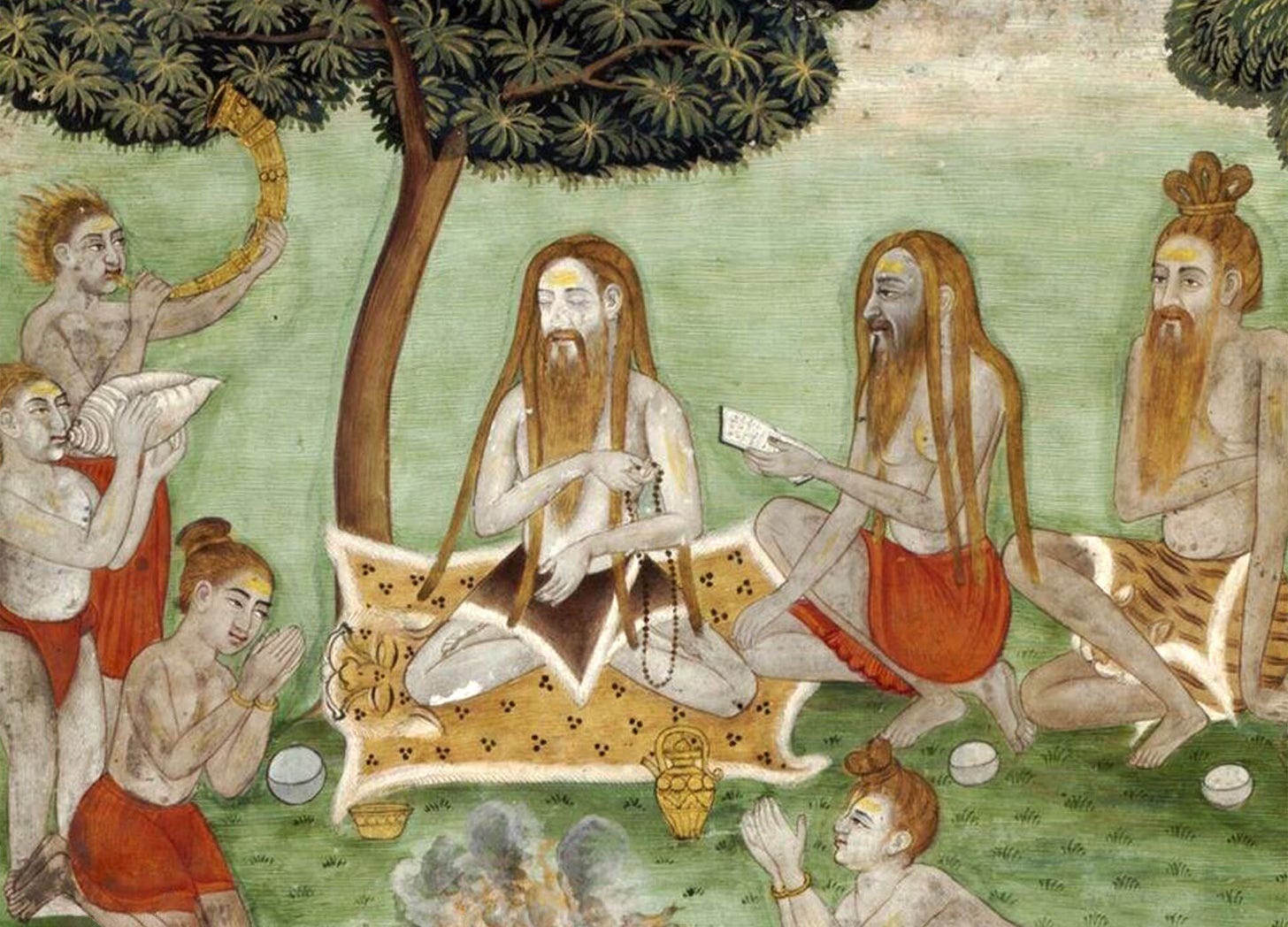
I’ve found myself exploring these sorts of ideas from a range of perspectives of late – from a module on my year-long course, The Path of Knowledge, to discussions on the meaning of freedom for modern practitioners. Meanwhile, parallels have also arisen on a Buddhist meditation course, where the focus is instead on the absence of self.
However teachings frame their solution, the problem is similar. To quote Roots of Yoga, by the scholars James Mallinson and Mark Singleton: “The goal itself was known as nirvāṇa (‘extinguishing’) or mokṣa (‘liberation’), and entailed the complete eradication of karmic traces, including the cessation of personal identity”, which seeks sensory fulfilment yet is never fully satisfied.
So the Upaniṣadic self, or ātman, is something very different to an individual self. It’s located in the heart and revealed by transcending the mind and the senses. Since this leads beyond the realm of language, it’s hard to describe, but it’s a conscious presence that encompasses everything. As Yājñavalkya puts it (Bṛhadāraṇyaka Upaniṣad 2.4.12): “this Immense Being has no limit or boundary and is a single mass of perception”.
In other words, distinctions of subject and object dissolve, so all that remains is an underlying knowing. “You can’t see the seer who does the seeing,” Yājñavalkya warns (Bṛhadāraṇyaka Upaniṣad 3.4.2), or “hear the hearer who does the hearing”, or any other entity behind the other senses, other than impersonal subjectivity. Hence: “The self within all is this self of yours. All else besides this is grief!”
What changes might this revelation yield? Dismantling a personal perspective sounds very different to contemporary ideas about self-improvement, self-help and self-care. How far is it compatible with everyday life? Is it better aligned with renouncing the world? Might there be ways to do both? Let me know what you think!
One potential implication in worldlier contexts might be compassion. We considered this last week in my online community, Yoga for Life. Texts mostly talk about freedom in individual terms, but a communal outlook “impels us to work tirelessly to alleviate the suffering of our fellow creatures”, says the 2009 Charter for Compassion.
How we approach this depends on our priorities, which is why it seems helpful to talk about ideas. It’s still possible to join us online – our first session was recorded and we meet next on December 14 – you can find out more and sign up here. Or come to Yoga Philosophy Club at The Shala on December 9 to discuss why we suffer…
If you’d like to support Ancient Futures, please consider paying to subscribe or send me fuel…
“Dismantling” makes it sound like your identity is some kind of structure that you take apart piece by piece. Hm, let me get rid of this anger thing. That doesn’t sound right. Identity is a tapestry, some are beautifully woven with bright colors and interesting scenes. Others are shabby and unattractive. But the process is the same for both. Continually shine the light of consciousness on that tapestry and like a piece of cloth left out in the sun too long, it begins to fade. Some aspects of Identity fade faster than others, some seemingly refuse to disappear (is it possible to completely shed identity?). But why would you go through all the trouble to achieve self-knowledge (at least it’s usually depicted as hard to reach) and then renounce the world? It seems somehow in that case that the knowing isn’t yet complete. Maybe the phrase "self-knowledge" is misleading, since we tend to forget that the self that is known is everybody’s self. How could you possibly walk away knowing that?
round and round as the self-other-Self questions go, I've always felt that there is an assumption behind which way we feel the teachings go.
Is the self pre-existent and internal, or is it not?
Is avidya a misunderstanding of what is right in front of us, or an ignorance that requires externals to fill?
The teachings I've studied most closely all lay into the former. Which, taken all the way, means we don't 'go' or 'renounce'. We stay where we are, but are there differently.
I kinda like the idea of a structured deconstruction. It fits. It tickles me. Of course, tossing out 'anger' is uncanny. But shifting from one experience of anger toward another possibility of experienced anger is possible, and would change the next moment, thus burning up some karma.
but that's me.