
Yogic Reminders
Flashbacks to a thought-provoking chat

This time ten years ago, I interviewed the editor and publisher of a new magazine called Pushpam. I’d first met the former – Genny Wilkinson – as a trainee journalist two decades earlier. And I’d practised with the latter – Hamish Hendry – at Aṣṭāṅga Yoga London.
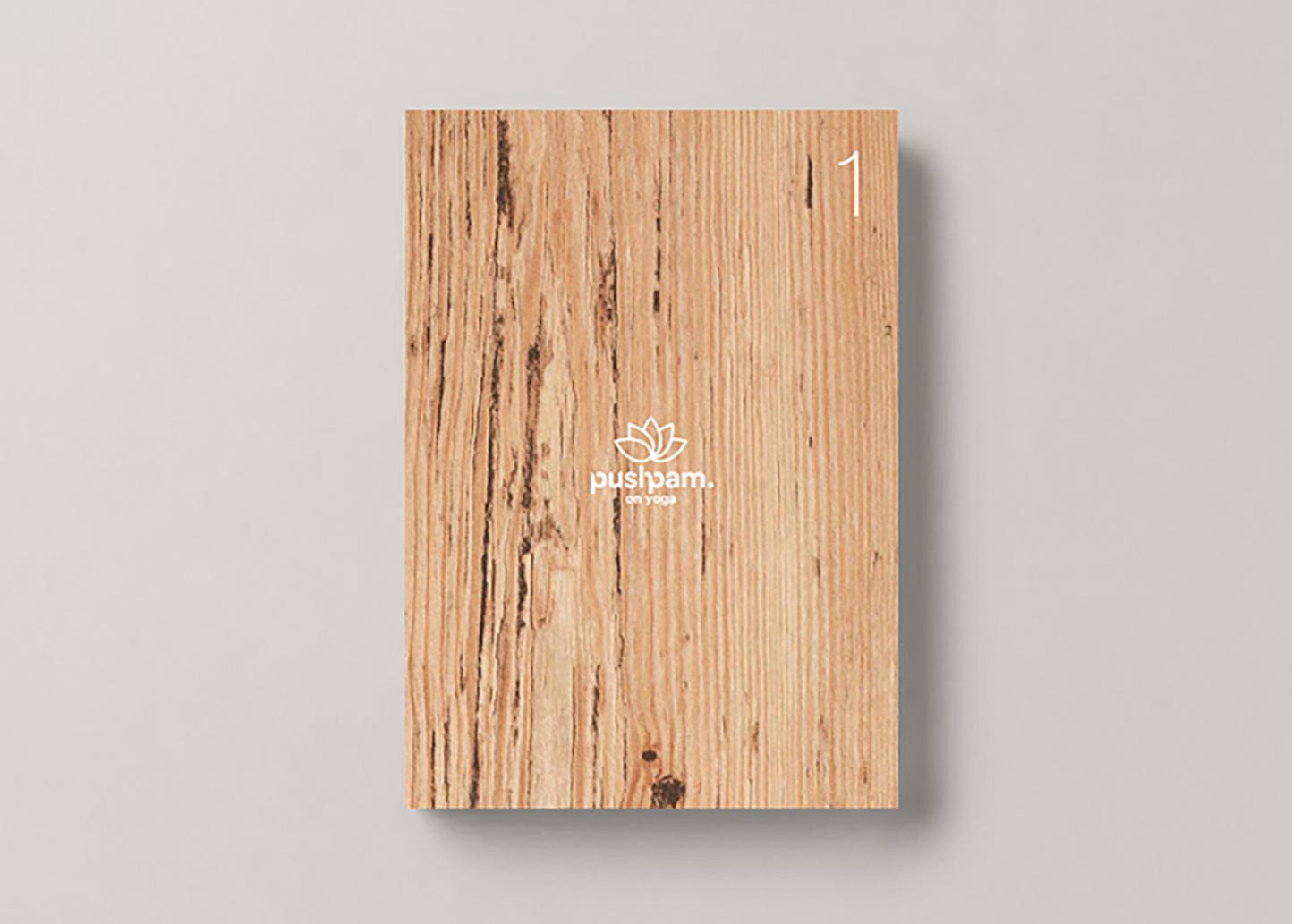
Appearing at an interesting time – yoga blogging was dying, social media had started imploding and glossy magazines were still hawking contortions – Pushpam strove to do something different, combining contributions from practitioners, teachers and scholars, as well as a cook. But although it succeeded, it ran out of steam.
Billed as “bi-annual (or so)”, it delivered in the sense of an issue every two years on average. The last was in 2022, and it’s unclear if another will appear. In the hope of a revival, I’ve brought back some memories of a fun conversation in Hamish’s kitchen.
INTERVIEW EXCERPT
From a conversation in 2016:
Q: In terms of sowing seeds, you say you aim “to inspire yoga students, helping them feel positive about their practice and hopefully learn a little bit more than what they discover on their own on the mat.” Presumably, that feeds back into what they do?
Hamish: Well hopefully, that’s if they end up thinking, yes. You know, the idea is that when people go on the mat, they’re like OK I’m doing yoga not just to stretch my hamstrings. They have some deeper reason for doing it, whether it’s a connection to God or just to feel calmer or whatever it is, but they’re doing yoga for more than just physical benefits. So I suppose I’ve just said what Pushpam’s about in one sentence: it’s not just about āsana. That’s all we need to say really. But we’re selling a magazine just to say that. And you know, filling people’s heads with other stuff, I suppose.
Q: What sort of stuff?
Hamish: I think one of our main things was that it shouldn’t be... is sectarian the right word? Where it’s like our system’s better than your system. You know, trying not to ostracise people. When we ask people to write, we always say the reader shouldn’t feel angry, or want to like kill the writer, the way people often feel when they read things online or in a newspaper. I don’t want people to have that feeling. The feeling people get after they read it is important to me. So it’s partly a feel-good thing to a certain extent, informed but feel-good.
Genny: We can be accused of being safe in that regard. Someone in Mysore said that to me. And I tried to explain to her that you didn’t have to create so much controversy that people separated. The whole point was to try to bring people together. Plus we were always conscious of moving away from āsana, though we knew we couldn’t avoid it completely.
Hamish: Yeah. But we’re definitely not doing “this is how to do bakāsana”, like other publications. Most yoga teachers say you can’t really learn from a book, or watching videos. I know everybody does, everybody watches Kino [MacGregor on YouTube] and then they try and replicate it. But that’s like well, you don’t have Kino’s body, as much as you might like it, so there’s no way you can do that.
Genny: We also didn’t want to be fluffy. I’m not sure if that was ever a conscious decision but...
Hamish: What do you mean, fluffy?
Genny: You know how a lot of those flaky yoga articles and New Age spirituality, it’s all saying nothing yet trying to seem like it’s rising well above but without any basis in real philosophy.
Hamish: Or even science. Like the whole... I don’t have any problems with cakras per se, but having never really gone “yeah, I’ve experienced that and I can honestly say I get it”, we haven’t... You know, I can talk about the theory of it, but we haven’t said: “drink this super-green smoothie and your heart cakra will open”.
Genny: Yeah, that kind of stuff.
Q: Hamish says in this issue: “people often forget the reason why they’re practising”. Then he asks Richard Freeman: “how do you get people to ask the question: Who am I?” That sounds way beyond asana.
Hamish: Yes, quite deep really. People get to that at some point. That question, you know they might read it, or they might hear it and they’ll go, huh, and they’ll put it in a box because they don’t really understand it, or don’t want to look at it. So they know of the question, but they don’t want to engage with it, because it’s not really a question that needs answering, certainly to start with. And then as you progress, it keeps sort of nagging you and you just gradually pay it more attention, so every now and again you’re like “yeah well, who am I really? Well, I’m not this, and I’m not that...” And there’s just a few seconds that informs your life and how you then behave.
Q: Does that necessarily have anything to do with āsana practice?
Hamish: I think the āsana practice has a major effect on your mind, and how you relate to the rest of the world – people and animals and non-living things. I think it stops you being so self-centred, in a way slowing time down so that you can focus a bit more and just pause, think about things. It’s mostly taking away the “I” from the equation…
Back issues of Pushpam are available here.
* For a broader perspective on yoga from multiple angles, join The Path of Knowledge *
If you enjoy what you find here, please consider subscribing – or buy me a virtual coffee…
Thanks for this, Daniel, an illustration of some of what was, and still is, generally unknown about Yoga, both through a lack of education originating from the modern source of it, Krishnamacharya, (neither Iyengar nor Jois studied with him long enough when they were a teenager in Iyengar’s case, and a young man in Jois’, to receive anything more than what Krishnamacharya felt was appropriate for these young male Brahmins — namely vigorous gymnastics for Iyengar and an incomplete use of coordinated breathing with it for Jois) and how Krishnamacharya himself had had his feet held to the fire in his later years by UG Krishnamurti over the idea of reaching some permanent transcendent state considered ‘enlightenment’. I certainly felt initial anger upon learning this, and then immense, ongoing gratitude.