
Garland or excrement?
Potential pitfalls of transliterated Sanskrit

A few weeks ago, I wrote about the tension between what texts say and the ways people use them to promote modern practices. On a related note, I’ve made another video (embedded below) responding to comments by a teacher on Instagram.
Posting here, Indu Arora says a popular “squatting position” – known in Sanskrit as mālāsana – “helps people who need easier bowel movements because it changes the angle of the rectum and relaxes the puborectalis muscle, reducing resistance”.
To bolster this description, she goes a step further, suggesting the name of the shape comes from mala, which literally means “dirt” and is used in Āyurveda – traditional Indian medicine – for bodily waste, including faeces. “Hence the name ‘defecation pose’,” Arora says, and “NOT Garland Pose”, as it’s commonly identified.
Her caption adds that “Mala is often confused with Mālā”, which means “garland” and is used for floral wreaths and strings of beads. However, what she says about the name seems to add to this confusion. It “has nothing to do with a garland, I can assure you,” Arora writes – despite there being no evidence of any other source for it.
The Encyclopaedia of Traditional Asanas, compiled by researchers at Kaivalyadhama, mentions two pre-modern texts that teach mālāsana – the Haṭhābhyāsapaddhati and the Śrītattvanidhi. These are closely related and provided inspiration for Krishnamacharya, an influential pioneer of modern yoga. Their descriptions are as follows:
“Place the hands on the ground and the knees on the shoulders. Raise the ankles and the thighs. This is mālāsana, the garland.”
— Śrītattvanidhi 44 (trans. Sjoman)
“Having supported oneself on the ground with the hands, one should place the knees on the shoulders, the heels on the chest and remain thus. This is the Garland pose.”
— Haṭhabhyāsapaddhati 57 (trans. Birch and Singleton)
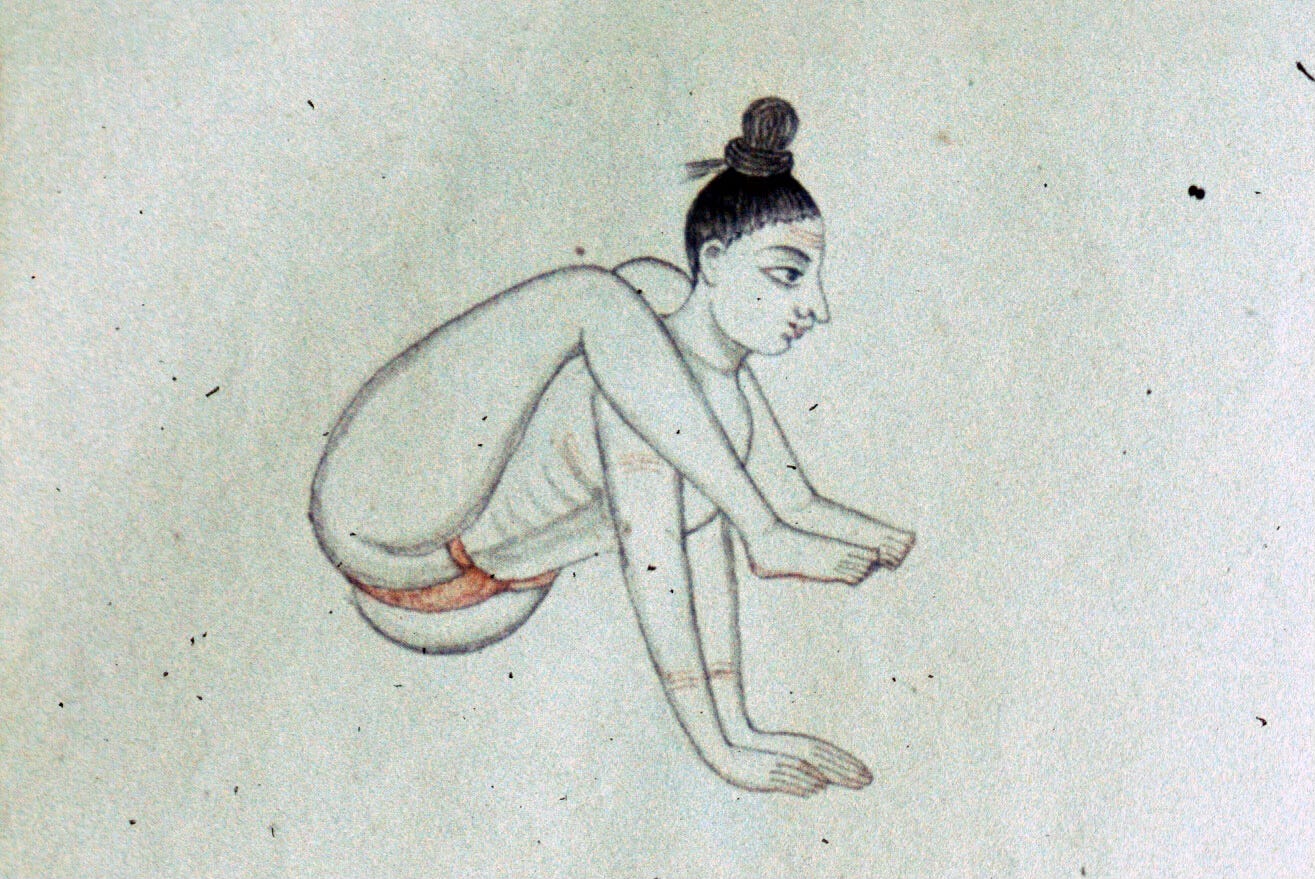
In other words, the legs are used to garland the torso, which couldn’t be done at the same time as squatting on them. So the original shape was different. As the scholars Jason Birch and Mark Singleton note, it seems to be an extension of the challenging backbend that immediately precedes it in the Haṭhābhyāsapaddhati.1
One of Krishnamacharya’s most famous students, B. K. S. Iyengar, teaches two forms of mālāsana, both of which involve squatting. Practitioners use their arms to encircle the legs so their hands can be clasped behind the back. As Iyengar writes in Light on Yoga, “the arms hang from the neck like a garland, hence the name.”
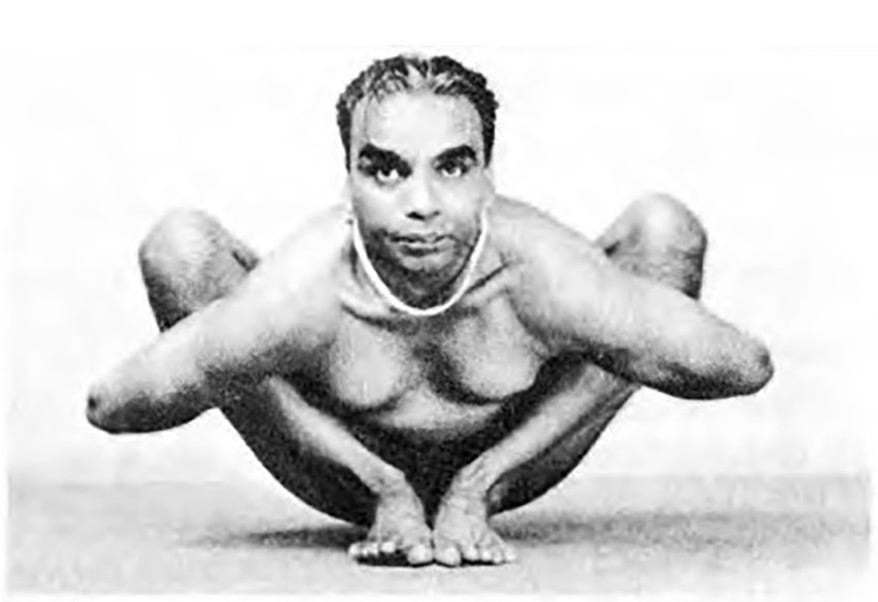
The names of these shapes combine mālā (i.e. “garland”) and āsana (a word meaning “seat” used for any yogic “posture”). No historical record exists of a compound based on mala. The alternative name for squatting was most likely invented to highlight the benefits Arora identifies. Yet she also says that speaking of “garland pose” is “doing a dis-service by mistranslating Sanskrit”, which is simply misleading.
There are nonetheless issues with how Sanskrit is transliterated. Some of its sounds have no direct equivalents in roman alphabets, so extra symbols such as dots and lines have to be added to render them accurately. These diacritical marks distinguish mālā (i.e. माला) from mala (i.e. मल), but they’re not widely used outside of academia.
To make my last book, The Truth of Yoga, as accessible as possible, I left out diacritics and adapted some spellings for ease of reading. Unfortunately, that would have meant that mālā looked identical to mala. Other books from the same publisher run into that problem, as the example in the video illustrates…
My new book, The Evolution of Modern Yoga, is a little more scholarly – but hopefully no less engaging – so I’ve included diacritics, as I do in all my teaching. You can find out more about the International Alphabet of Sanskrit Transliteration (IAST) here. The easiest way to type it is using this keyboard.
VIDEO
Via my Instagram @truthofyoga
* To explore the evolution of yogic traditions, join us on The Path of Knowledge *
If you enjoy what you find here, please consider subscribing – or make a donation…
For more detail, see p.22 of their article, which says: “It is also worth noting that the sequential nature of the Haṭhābhyāsapaddhati’s descriptions of āsanas aids the reader in understanding them. In many cases, the terse description of an āsana can only be understood by considering the one that precedes it. For example, the description of the garland pose (mālāsana) is perplexing when it is read by itself, because it simply says that the yogin should place his bodyweight on the hands, knees on the shoulders, and heels on the chest.One might think that this has to be done from a squatting position. However, when squatting, the spine is flexed and this makes it is impossible to place the feet on the chest when the knees are above the shoulders. If one considers the parasol pose (chatrāsana), which is the posture that precedes mālāsana in the Haṭhābhyāsapaddhati, the yogin is in an extreme back-bend with his feet placed on the back of the head and his bodyweight entirely on the hands.”
Great post, Daniel. So much of modern "mainstream" yoga interprets postures, quotes, and history (etc) with a "wishful thinking" angle, rather than learning about what is, prior to making an opinion about it. But I guess in a world where everybody has "their own truth", all interpretations are considered equally valid, despite the reality of the Sanskrit. Would you say that this "free" way of interpreting reality has its roots in Theosoohy / New Thought, where thoughts are supposedly able to create reality? Or can they be found in premodern Indian thought?