
What's Authentic?
Is it more about tradition or individuality?

To what extent is authenticity about being faithful to personal preferences? 🤔
The evolution of yoga shows that traditions doesn’t have to be old to be authentic. However, that raises the question of how innovations align with the past, as well as whose authority defines what’s yogic and what isn’t.
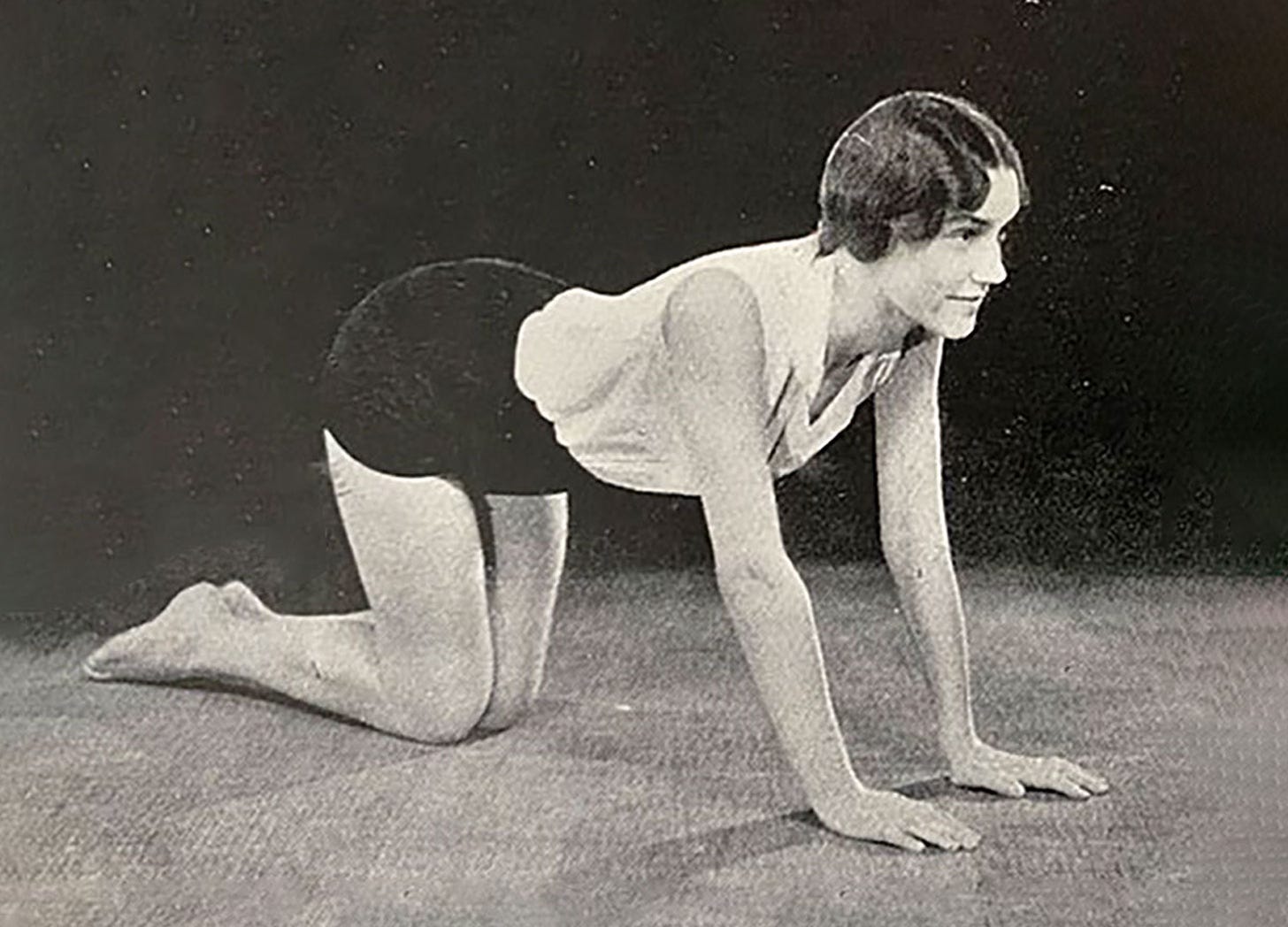
As we discussed in a recent philosophy club, this is complicated by many layers of cultural exchange. Some techniques now presented as yoga began as something else, as in the example on the image above – from a 1930s exercise manual by Mollie Bagot Stack. Arching the spine up and down is widely taught today as the “cat” and “cow” postures, but there’s no trace of this movement in pre-modern yoga texts.
The Oxford English Dictionary defines authentic as “legally valid” and “in accordance with fact or stating the truth”. However, it also adds that “the usual sense” in modern usage is “not feigned or false”, and what “truly reflects one’s inner feelings”.
These alternatives illustrate a tension between and objective fact and what’s often called “my truth”. This sometimes arises in people’s discussions of yoga history, which is usually framed to endorse what they teach. One example that crossed my screen in recent days (embedded below) is from the prominent teacher Simon Borg-Olivier.1
In the video, he outlines a variant on alternate nostril breathing. This uses the tongue – instead of fingers and thumb, as is commonly taught – to restrict the flow of breath. The caption attributes this to the fifteenth-century Haṭhapradīpikā, whose historical authority provides validation. As Borg-Olivier’s narration puts it: “This is what’s meant to be done”, because it’s “the way it’s described in the texts”.
That claim stems from a reference to baddhapadmāsana – the “bound lotus posture” – in Haṭhapradīpikā 2.7. Today, this name means what the video shows – wrapping arms behind the back to hold each foot. But there’s no indication of this in the text, despite Borg-Olivier’s suggestion that “it says take your right hand around the body and grab your right leg, and take your left hand around the body, grab your left leg...”
With both hands clasping the feet, there’d be no way of using them to close alternate nostrils at the same time. Hence Borg-Olivier’s rationalisation for using the tongue, which turns upward and backward to plug nasal cavities.
However, none of that is taught in the Haṭhapradīpikā, which gives no explanation of baddhapadmāsana. A new scholarly edition (available here) translates it simply as “the lotus pose”, in which legs are bound together in a pretzel shape. There’s no suggestion that hands are bound too, requiring other techniques to be used for breath-control.
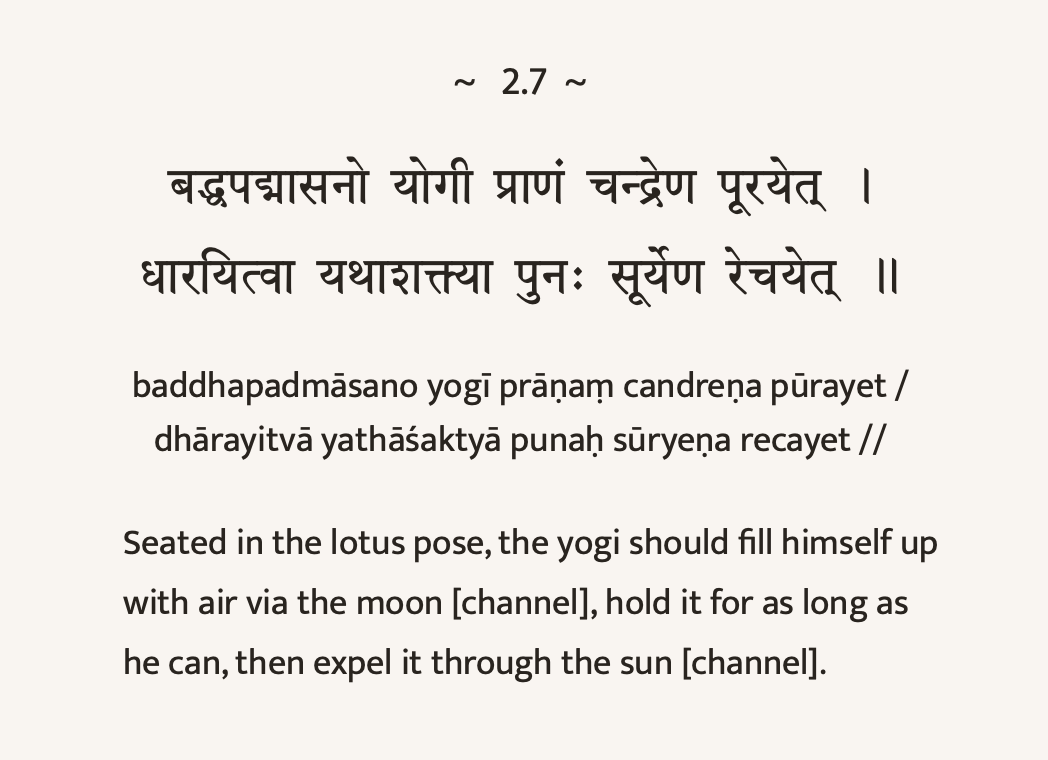
Meanwhile, an earlier source – the Dattātreyayogaśāstra (available here) – teaches alternate nostril breathing using hands. Sitting in padmāsana, it says in verses 59-60, “the wise man should block the Piṅgalā [the right channel, linked to the sun] with the thumb of the right hand and slowly inhale through the Iḍā [the lunar left channel]”.
None of which is to suggest that there’s no potential benefit to using the tongue. But it’s simply misleading to say that doing otherwise “is not how the old texts describe it”, particularly when this is geared to selling workshops and trainings.
“I believe we’ve just simplified what we couldn’t do,” Borg-Olivier’s caption says. “So real yoga is much more complex, and often stranger, than only doing fancy postures in fancy clothes”. Hence: “If you want to learn more, join me live or online.”
In that spirit, if you want to learn more about how yogic traditions relate to modern practice, join me online for my year-long course, The Path of Knowledge… 🙃
N.B. I commented on Borg-Olivier’s reel. He replied: “thank you for sharing this. Will look into it. I haven’t really updated my knowledge on this for a while!” I also made a video here.
* For a comprehensive overview of yogic traditions, join us on The Path of Knowledge *
If you enjoy what you find here, please consider subscribing – or make a donation…
Thanks to Darya parle de yoga for sharing the link.
I enjoyed this Daniel! A bit of interesting background on Mollie Bagot Stack is that she spent time in India pre WW1 where she did have a yoga teacher who came to the house to teach her though I think more breath work and philosophy than asana. She based a lot of her movement work on the observations she made about the agility and flexibility of the local population - able to squat etc. She also shocked her neighbours by planting her flowers to spell ‘Votes for Women’! Quite an interesting lady!